QUALIFIED BUYER SUPPORT
Compare factory quotations on the same keystone-jack configuration.
Eligible orders may receive up to 3%.
Eligibility applies to qualified business buyers and is confirmed after we review your product, quantity, destination, and sourcing requirements.
Project translation · horizontal cabling drops
A closet, a floor serving a call center, and a small equipment room can all ask for the same beige opening and still need different jack lines. LinkScope Sourcing 26 reads the project as a purchase brief: which opening, which pairs, which test, which delivery stage. The room label does not set the keystone jack cat6 price.
This page stays inside Cables & Wiring. It does not design the switch, the fiber backbone, or the rack. Those disputes have their own evidence and should not be borrowed to decorate a jack RFQ.
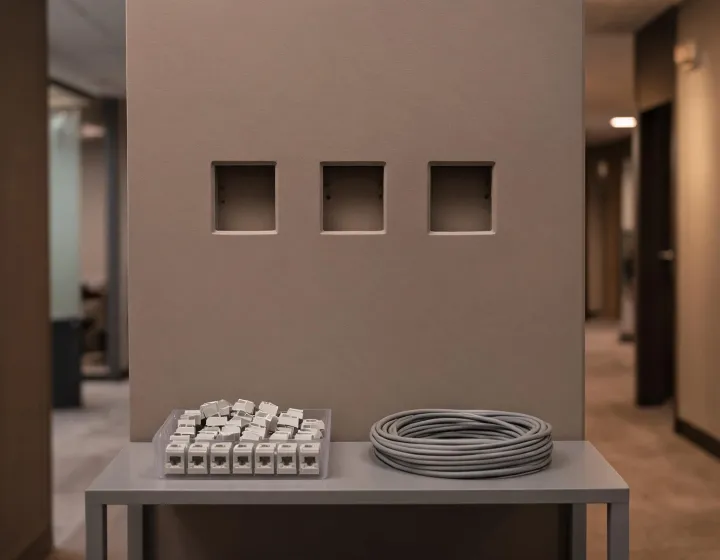
Use one row per drop type. A workstation outlet and a wireless access-point outlet can share a faceplate size and still differ on Power over Ethernet current through the contacts. Write the difference before you ask for one keystone jack cat6 price.
| Project use | Jack fields to lock | Documents and site limits |
|---|---|---|
| Workstation outlet | Category, T568A or T568B, unshielded unless the drawing says otherwise, color, icon | Faceplate opening count, furniture feed, and whether the installer punches on site |
| Access-point or camera drop | Same category as the horizontal cable, shield if the plant is shielded, contact current question | Ceiling box versus wall plate, temperature around the jack, and who accepts the link test |
| Patch-panel rear | Panel opening, not a decorator faceplate, angled or flat if specified | Rack delivery stage, labeling scheme, and whether blanks are in the same carton |
| Surface-mount box | Jack plus box as separate lines, strain relief, and screw kit | Masonry or furniture mounting, and a destination that can receive small cartons |
| Drop check | Number to record | What it does not prove |
|---|---|---|
| Frequency range | 250 MHz on a Cat6 question, 500 MHz on a Cat6A question | The room name |
| Insertion loss / return loss | The limit at that frequency for the named model | A channel built from a different jack |
| Impedance | The stated value, often near 100 ohms, with the test condition | A memory number |
| Contacts | 8P8C, plating if the drawing says 50 microinches (1.27 micrometers) | Beige plastic |
| Power over Ethernet | 15.4 W, 30 W, 60 W, or 90 W when that clause is in the drop | A camera icon |
| Connector mating cycle | The datasheet count, and whether the lot is new | A wiped housing |
Managed versus unmanaged equipment is a switch argument about monitoring and configuration overhead. It does not change an 8P8C contact. Single-mode versus multimode is an optical argument about fiber plant, wavelength, and reach. A copper keystone has no optical budget and no receiver sensitivity. If the project also buys optics or switches, give them another sheet. Keep frequency range, insertion loss, return loss, and near-end crosstalk on the copper row, with the megahertz limit the supplier actually tested.
Two arguments do belong here. A specified-brand housing versus a compatible housing changes fit, marking, and who supports a complaint. New jacks versus surplus or pulled jacks change contact wear, plating condition, and whether a mating-cycle statement still means anything. Ask for condition in writing. A photograph of a clean beige part is not a condition code.
Name the outlet job: data only, data plus Power over Ethernet, or a jack that must also pass a shield bond. State the cable category already pulled, because a Cat6 jack on a Cat6A cable does not upgrade the channel, and a Cat6A jack on a Cat6 cable does not create a 500 MHz channel by itself. Note 4 pairs and whether the horizontal cable is 24 AWG or 23 AWG. Measurement accuracy of the site tester is a separate instrument question. Impedance near 100 ohms is a discussion point for the pair, not a number this site measured.
Outline drawing for the opening, pinout sheet, pack list, and the incoming check you will run (visual plating, shield finger if any, and a link test if you own the tester). Delivery stages matter: jacks for a rough-in week and jacks for a furniture-install week should not be one undifferentiated carton if the site cannot store both. US destination includes the dock rules you already know. We will not invent a street address for you.
An unshielded jack in a shielded channel leaves the foil or braid without a planned bond. A shielded jack in an unshielded channel adds a shell you may not ground. Choose with the cable construction, then make every quote repeat that choice. Do not let a supplier “upgrade” the shield silently because the unit price was close.
Length and bend radius describe the cable, not the jack body. Put them on the cable line of the same project brief so a factory does not fold them into the jack. Jacket rating (riser, plenum, or another mark the specification names) follows the cable as well. The jack still needs its own termination and test requirement.
When the rows are stable, move the names to the product list or send the sheet through the requirement desk. The procurement brief repeats the evidence columns in article form.
There is no file upload on this form. Copy the outlet counts, pinout, shield choice, and destination into the requirements box. One paragraph per drop type keeps Cat6 and Cat6A from collapsing into a single keystone jack cat6 price. If a row is still unknown, write “unknown” rather than a guessed plating thickness.
The desk then asks factories to answer that text. You still decide whether a compatible body or a surplus lot is acceptable. Nothing on this page pre-approves either path.